"Trust"in Education
- Siana_1996
- Feb 1, 2025
- 3 min read

Despite all initiatives of change in education in Nepal, one thing is constant: the progress in education has been insignificant. The Constitution ensures education as a fundamental right, it is of highest importance in national budget distribution, transnational and national organizations are investing in it and many local level reform projects are going on for decades. However, the condition still remains the same. Apart from a few elite schools, most educational institutions are struggling to provide quality education. In fact, the problem of access to education is the reality in many rural and marginalized communities. Not just scholars, educators and leaders, but every average citizen can make a list of problems in education in Nepal. Among all points, accountability and ownership stands out repeatedly.
Then, what causes the lack of accountability and ownership? What is fundamentally going wrong in the dream of educational transformation in Nepal?
Perhaps the answer is too simple that it easily gets overlooked. Perhaps the answer lies in the basic human virtue: trust.
The realm of education in Nepal is not even discussing the importance of trust let alone practicing it;
Administration do not trust teachers can teach effectively.
Teachers do not trust administration treats everyone equally.
Teachers do not trust parents takes care of children.
Parents neither trust school, nor teacher, nor their own children on teaching and learning process.
Municipality do not trust headmasters and teachers can create effective learning environment.
NGOs and INGOs do not trust the expertise of government officials.
Community do not trust school to fulfill academic needs of all children.
Teacher do not trust student's ability to learn
When there is no confidence and respect, every entity becomes dysfunctional. After all in all those labels and positions, there are individuals spending their time and energy. Education is not an election campaign to make one person stand out. It is a continuous collective process of making each children leader of their life. Tragically, we have been applying the same political scheme in education as well which is already a failure from all aspects.
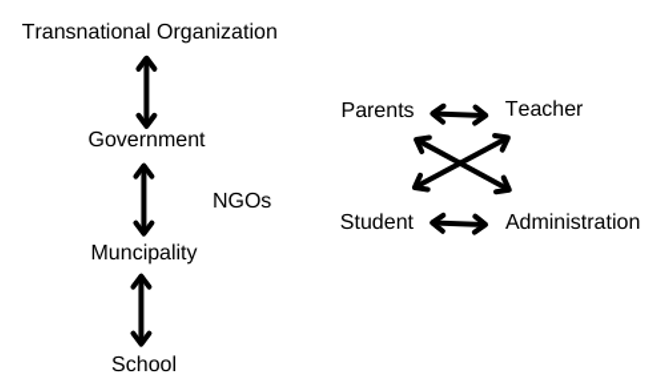
It is a common scene in many schools that teachers would be wasting their time talking about what the principal is doing wrong, instead of preparing lesson plans and activities. On the other hand, the principal would be busy formulating tactics on how to make teachers obey them rather than developing a strategy on capacity building of teachers. Similarly, parents enjoy making a cluster to exchange their opinion on how teachers should be teaching instead of interacting with children about their interests and needs. The issue with NGOs and INGOs is that they simply dismiss policies and systems of government instead of collaborating with them. And the government, rather than driving the transformation, spends resources on dominating teachers.
In short, everyone is aware of what other people, professionals or entities should be doing, but completely unaware of what they themselves should be doing. All are misusing their power and are being oppressive towards others. The lack of mutual trust causes generations of children to suffer. And the children, grown up in such environments, mirror those behavior as an adult.
Without building trust, no investment is going to create an impact. It cannot happen we get the desired result in the absence of complete reliability on each other. And the trust (if recognized as utmost need) cannot be established with manipulation and superficial action. It is possible only with genuine care and interest which requires commitment, respect, sensitivity and time.
The solution of trust may sound easy, but is the hardest to achieve. Unfortunately, the current educational status reflects the complexity quite clearly.
Comments